---
title: "Guidelines for Do's and Don'ts in brand kits"
slug: "guidelines-for-do-s-and-don-ts-in-brand-kits"
abstract: "Learn how to create effective Do's and Don’ts rules in your brand kit to ensure AI-generated, optimized, and translated content consistently aligns with your brand standards."
---
# Guidelines for Do's and Don'ts in brand kits
The **Do's and Don’ts** section of a brand kit defines rules for tone, language, style, terminology, and brand usage. These rules are evaluated by AI across conversational responses and translations, to ensure both the brand voice and the way the AI answers remain consistent.
Do’s and Don’ts rules influence not only what the AI says, but also how it responds, such as phrasing, level of formality, preferred terminology, and response behavior in chat-based interactions.
Do's and Don'ts rules can be generated automatically during [brand kit creation](https://doc.sitecore.com/stream/en/users/sitecore-stream/create-a-brand-kit-in-sitecore-stream.html "Create a brand kit in Sitecore Stream") and document ingestion, or [added or refined manually](https://doc.sitecore.com/stream/en/users/sitecore-stream/create-a-brand-kit-in-sitecore-stream/guidelines-for-do-s-and-don-ts-in-brand-kits.html#UUID-50667537-d5bf-8bb4-38b4-36fb28cd1141_N1765867330046 "Add Do's and Don'ts rules in a brand kit") by brand kit admins.
## How Do’s and Don’ts rules are applied
Do’s and Don’ts rules are applied by AI in the following scenarios:
- [Brand Assistant chats](https://doc.sitecore.com/stream/en/users/sitecore-stream/using-the-brand-assistant.html "Using the Brand Assistant") (in Stream or Content Hub) - rules guide how the assistant responds.
- AI-assisted item and page translations (in Experience Platform) - rules help ensure brand consistency across languages.
Some rules apply across all AI interactions, while others are evaluated only in specific scenarios.
## Add Do's and Don'ts rules in a brand kit
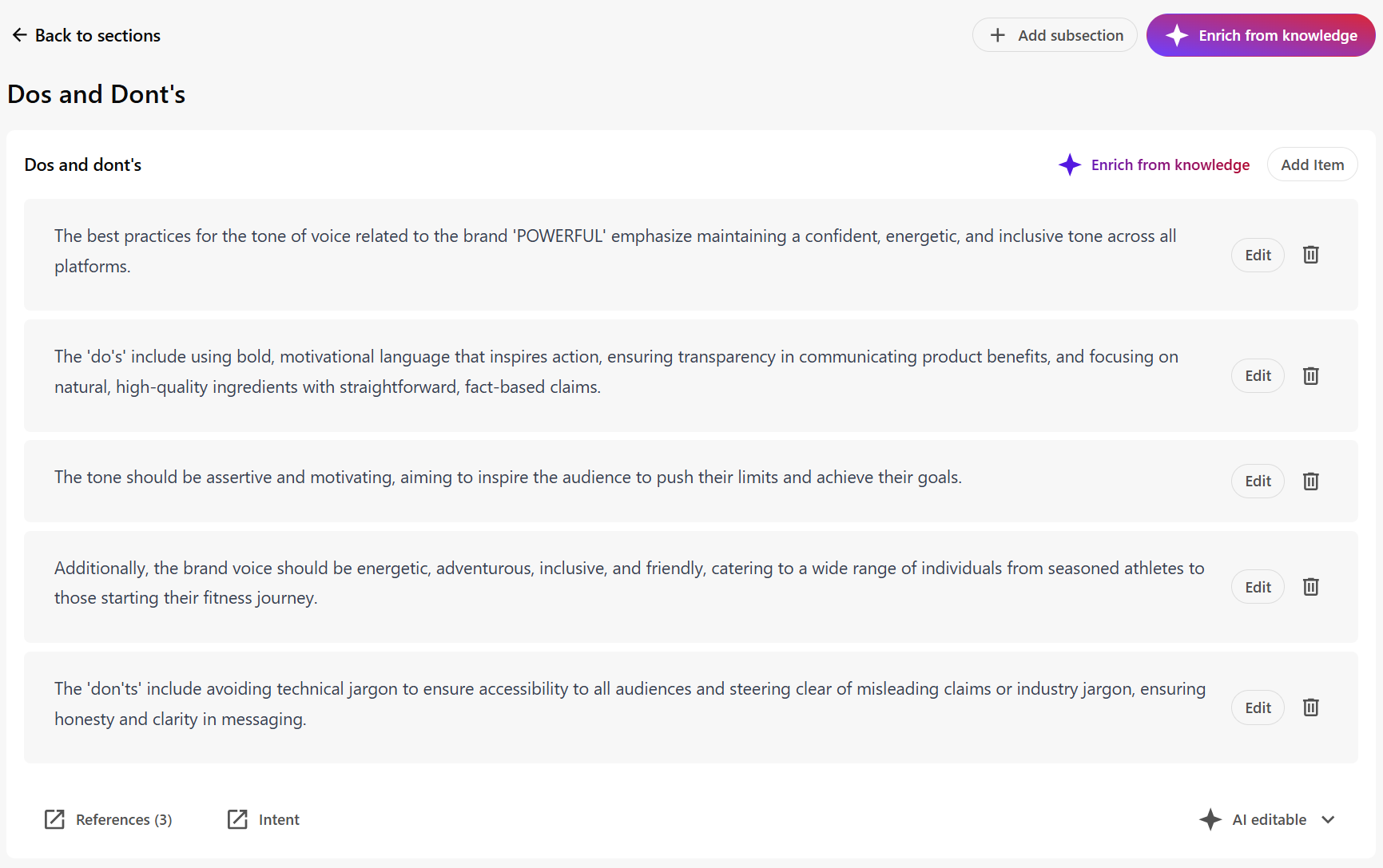
Admins can manually add new rules in the **Do's and Don'ts** section of a brand kit to guide how the AI responds in specific situations, such as tone, response style, or how certain questions are handled.
These rules are applied during Brand Assistant chats and site and page translations.
> [!note]
> **Before you begin**
> Make sure you **check existing rules**. The **Do's and Don’ts** section might already be prefilled from the brand kit ingestion process.
To add Do's and Don'ts rules in a brand kit:
1. In the Stream navigation menu, click **Brand kits**.
2. On the **Brand Kits** page, click the brand kit you want to edit.
3. On the **Sections** tab, click the **Do's and Don'ts** section.
4. Do one of the following:
- Click **Edit** to modify any existing rule generated from uploaded brand documents.
- Click **Add item** to create a new rule and provide an example for context.
> [!tip]
> When adding or editing rules, keep the following in mind:
>
> - **Avoid duplicates or contradictions** - update existing rules instead of adding conflicts.
>
> - **Follow best practices** for [Brand Assistant chats](https://doc.sitecore.com/stream/en/users/sitecore-stream/create-a-brand-kit-in-sitecore-stream/guidelines-for-do-s-and-don-ts-in-brand-kits.html#UUID-50667537-d5bf-8bb4-38b4-36fb28cd1141_section-id235317864805226 "Using Extend and Restrict rules for Brand Assistant chats") and [terminology handling](https://doc.sitecore.com/stream/en/users/sitecore-stream/create-a-brand-kit-in-sitecore-stream/guidelines-for-do-s-and-don-ts-in-brand-kits.html#UUID-50667537-d5bf-8bb4-38b4-36fb28cd1141_section-id235315719059321 "Using terminology rules for translation") in translations.
>
> - See examples of [Brand Assistant chat](https://doc.sitecore.com/stream/en/users/sitecore-stream/create-a-brand-kit-in-sitecore-stream/guidelines-for-do-s-and-don-ts-in-brand-kits.html#UUID-50667537-d5bf-8bb4-38b4-36fb28cd1141_section-id235317864805226 "Using Extend and Restrict rules for Brand Assistant chats") and [translation](https://doc.sitecore.com/stream/en/users/sitecore-stream/create-a-brand-kit-in-sitecore-stream/guidelines-for-do-s-and-don-ts-in-brand-kits.html#UUID-50667537-d5bf-8bb4-38b4-36fb28cd1141_section-id235315719059321 "Using terminology rules for translation") rules.
5. Click **Save** to apply your changes.
6. To prevent manually added rules from being overwritten during future document republishing or enrichment, in the lower-right corner of the section, click  **AI editable** > **Non AI editable**.
## Using Extend and Restrict rules for Brand Assistant chats
For [Brand Assistant](https://doc.sitecore.com/stream/en/users/sitecore-stream/using-the-brand-assistant.html "Using the Brand Assistant") interactions in Stream and Content Hub, Do’s and Don’ts rules can be used to control how AI responds to user questions and requests by defining *Extend* and *Restrict* rules. These rules affect response behavior, such as phrasing, structure, and what information is included or excluded.
Using *Extend* and *Restrict* rules is optional. If they are not defined, the Brand Assistant interprets and applies the Do’s and Don’ts rules automatically based on context.
### Extend rules
Extend rules modify Brand Assistant responses by appending, replacing, or injecting predefined content. They can apply globally or only when specific conditions are met.
Use Extend rules when you want to add guidance or messaging without blocking the Brand Assistant from answering.
**Syntax**: #Extend#
#### Extend rule examples
Respond in a specific way for a topic
Use when you want the Brand Assistant to return a predefined message whenever a topic is detected.
**Example**
```
#Extend# When a user asks a question about pricing, append the following message:
"Pricing information may vary by region and is subject to change."
```
**Result**
Instead of searching for information and generating its own answer, the Brand Assistant always returns the predefined message for pricing-related questions.
Add a message to all responses
Use when the same message must appear in every Brand Assistant response, regardless of topic.
**Example**
```
#Extend# Always add at the end:
"AI can make mistakes. Always verify responses."
```
**Result**
The Brand Assistant generates its response and appends the same message every time.
Add a message for a specific subject
Use when you want the Brand Assistant to append a predefined message to its response only when a particular subject is detected.
**Example**
```
#Extend# When a user asks about Powerful products, add:
"Powerful products are consumer-friendly."
```
**Result**
The Brand Assistant responds normally and adds the message only for questions about Powerful products.
### Restrict rules
Restrict rules prevent the Brand Assistant from responding to specific types of questions or performing certain actions.
Restrict rules are typically used for topics that the assistant must not answer directly, such as competitors, legal statements, or unsupported claims.
When a Restrict rule is triggered, the Brand Assistant does not generate an answer. Instead, it returns a predefined response to ensure consistent handling of restricted topics.
**Syntax**: #Restrict#
#### Restrict rule example
Block responses for a specific topic
Use when you want the Brand Assistant to stop generating its own answers and instead return a predefined response whenever a restricted topic is detected.
**Example**
```text
#Restrict# When a user asks a question related to competitors to say: We do not share information about competitors
```
**Result**
When a user asks a competitor-related question, the Brand Assistant does not search for information or generate an answer. Instead, it always returns the predefined response.
The response also includes the rule context to explain why the request cannot be fulfilled, ensuring consistent and transparent handling of restricted topics.
## Using terminology rules for translation
For AI-assisted item and page translations in Experience Platform, Do’s and Don’ts rules can be used to control how AI handles and protects terms by defining terminology-focused rules in the brand kit. These rules affect how terms are translated, preserved, or adapted to ensure brand-safe and consistent translations to maintain:
During translation, terminology rules help AI maintain:
- **Brand consistency** - brand names, trademarks, and key messaging remain correct across all languages.
- **Accuracy** - certain terms and phrases are translated, preserved, or adapted in ways that align with your brand.
- **Clarity** - unwanted or incorrect translations that could confuse your audience are avoided.
Using terminology rules is optional. If no terminology-specific rules are defined, AI applies the Do’s and Don’ts rules automatically based on context during translation.
### Best practices for translation-related rules
When creating Do’s and Don’ts rules for translation, structure your rules by intent. Clear intent helps the AI apply rules consistently and reduces conflicts.
Follow these core principles before defining individual rules:
#### Core principles
Keep rules simple and specific
Avoid vague instructions. Write clear rules with enough detail for AI to understand how to handle translation.
**Example of a vague rule**
```text
Translate correctly.
```
**Excample of a clear rule**
```text
Translate all body text, but do not translate quoted product names.
```
Maintain consistency
Avoid overlapping or conflicting rules. Too many exceptions can lead to unpredictable behavior.
**Examples of conflicting rules**
```text
Translate “Powerful”.
```
```text
Do not translate brand names.
```
Provide one example per rule
Examples clarify intent and help validate translation outcomes. Identify specific terms using quotation marks.
**Example**
```text
Always translate “Customer Portal” as “Πύλη Πελατών” in Greek. For example, “Access your account through the Customer Portal” should be translated into Greek as “Αποκτήστε πρόσβαση στον λογαριασμό σας μέσω της Πύλης Πελατών”.
```
Use rule types
Organize terminology rules based on the [type](https://doc.sitecore.com/stream/en/users/sitecore-stream/create-a-brand-kit-in-sitecore-stream/guidelines-for-do-s-and-don-ts-in-brand-kits.html#UUID-50667537-d5bf-8bb4-38b4-36fb28cd1141_section-id235315800004482 "Translation rule types") of translation behavior you want to control.
**Example**
```text
Never translate "IT support".
```
#### Translation rule types
Write each rule as a clear instruction, followed by one or more examples showing how the rule applies in context.
> [!note]
> The examples in this section use *English-to-Greek* translations for illustration. The same rule types apply to any source and target language.
Rules for terms that must always be translated
Use these rules to ensure specific terms are translated consistently into their approved local equivalents.
**Examples**
```text
Always translate “Velora” to “Βελορά” in Greek. For example, “Velora targets 30-45 year old customers” should be translated into Greek as “Η Βελορά απευθύνεται σε πελάτες ηλικίας 30-45 ετών”.
```
```text
Always translate “Customer Portal” as “Πύλη Πελατών” in Greek. For example, “Access your account through the Customer Portal” should be translated into Greek as “Αποκτήστε πρόσβαση στον λογαριασμό σας μέσω της Πύλης Πελατών”.
```
Rules for terms that must never be translated (protected terms)
Use these rules to protect brand names, product names, or technical identifiers.
**Examples**
```text
Never translate the brand or product name “Powerful”. Always leave it unchanged. For example, “Powerful is brand dedicated to fueling the potential of active individuals” should be translated into Greek as “Η Powerful είναι μια μάρκα αφιερωμένη στο να ενισχύει το δυναμικό των ενεργών ανθρώπων”.
```
```text
Never translate domain names or URLs. For example, keep "support.sitecore.com” unchanged in all languages.
```
Rules for terms that should be adapted (localization rules)
Use these rules when content should be localized rather than translated literally.
**Examples**
```text
Convert units and currencies to local standards. For example, “Free shipping over $50” should be translated into Greek as “Δωρεάν αποστολή για αγορές άνω των 50€”.
```
```text
Use local numeric and decimal formats. For example, “5 miles” should be translated into Greek as “8 χιλιόμετρα” and "1,000.00” to “1.000,00”.
```
```text
Adapt slogans to preserve intent rather than literal meaning. For example, the slogan “Built for bold ideas” should be translated into Greek as “Φτιαγμένο για τολμηρές ιδέες” to maintain its motivational tone.
```
```text
Replace idioms with culturally relevant equivalents. For example, “As easy as pie” should be translated into Greek as “Εύκολο σαν παιχνίδι”.
```