---
title: "Walkthrough: Adding the Horizon module"
slug: "walkthrough--adding-the-horizon-module"
abstract: "Describes the infrastructure changes necessary to add the Horizon module."
---
# Walkthrough: Adding the Horizon module
Horizon is the next-generation editor in Sitecore Experience Platform. To add the Horizon module, you must create specific Docker images, add them to the Azure Container Registry (ACR), and then change the item in the Application repository before running the Mssql containers. You must also extend the Front Door configuration with an additional public-facing service name.
This walkthrough describes the infrastructure changes that you have to apply when you want to deploy the Horizon module on top of an already deployed Managed Cloud containers environment.
This walkthrough describes how to:
- Register a domain name
- Extend the Front Door configuration
- Prepare the Docker files
- Push the images to the Azure Container Registry (ACR)
- Download the Horizon Container Deployment package
- Copy the base Horizon Kubernetes configuration files
- Define Horizon configuration overlays
- Change the image in the Application repository
- Run the mssql_init_hrz container
- Configure Ingress
- Enable the Horizon component
- Apply the change
Register a domain name
Because Horizon is a separate publicly available service, you must register a domain name for it.
To register a domain name:
1. Navigate to the portal where your DNS name is managed from.
2. Create an additional CNAME record for Horizon that points to Azure Front Door: `{infrastructure_id}fdr.azurefd.net`,
where `infrastructureId` is your environment identifier that starts with `mcc`.
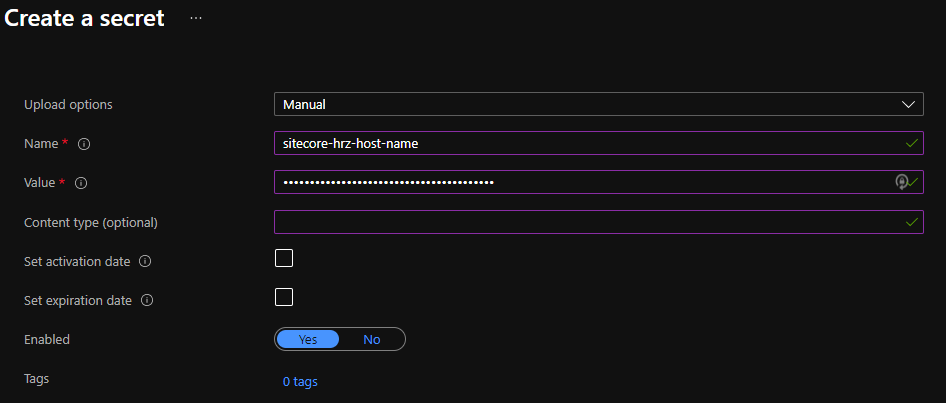
3. Navigate to the [Azure Portal](https://portal.azure.com/) and create a secret within the Key Vault for the environment:
- Secret name - `sitecore-hrz-host-name`
- Secret value - the Horizon hostname that you created in the previous step.
Extend the Front Door configuration
You must extend the Front Door configuration with an additional public-facing service name.
To extend the Front Door configuration:
1. Navigate to `frontdoor\backend-config.json` and define the Horizon back-end config:
```csharp
{
"name": "hrz-ingress",
"probe_path": "/healthz/live",
"backend_list": [
{
"host_header": "hrz.sitecore"
}
]
}
```
2. Navigate to `frontdoor\main.tf` and in the `locals` section, add a new variable to `"sitecore_hrz_host_name“`:
```text
sitecore_hrz_host_name = data.azurerm_key_vault_secret.sitecore_hrz_host_name.value
```
3. Define the `data` resource to retrieve the Horizon host name from the Key Vault:
```csharp
data "azurerm_key_vault_secret" "sitecore_hrz_host_name" {
name = "sitecore-hrz-host-name"
key_vault_id = data.azurerm_key_vault.this.id
}
```
4. In the `"azurerm_frontdoor"` resource, define an additional `routing_rule`:
```csharp
routing_rule {
name = "HTTPS-hrz"
accepted_protocols = ["Https"]
patterns_to_match = ["/*"]
frontend_endpoints = ["hrz-frontend-endpoint"]
forwarding_configuration {
forwarding_protocol = "MatchRequest"
backend_pool_name = "hrz-ingress"
}
}
```
5. In the `"azurerm_frontdoor"` resource, define the `frontend_endpoint`:
```csharp
frontend_endpoint {
name = "hrz-frontend-endpoint"
host_name = local.sitecore_hrz_host_name
}
```
6. Adjust `HttpToHttps` so that it covers the `HTTPS-hrz` routing rule:

7. You must now apply the changes with a pull request to the Infrastructure repository before you can continue with the next steps.
8. Run the [FrontDoor pipeline](https://doc.sitecore.com/xp/en/developers/101/managed-cloud/the-managed-cloud-standard-pipelines.html "The Managed Cloud Standard pipelines") to apply the changes and wait until the pipeline is executed successfully.
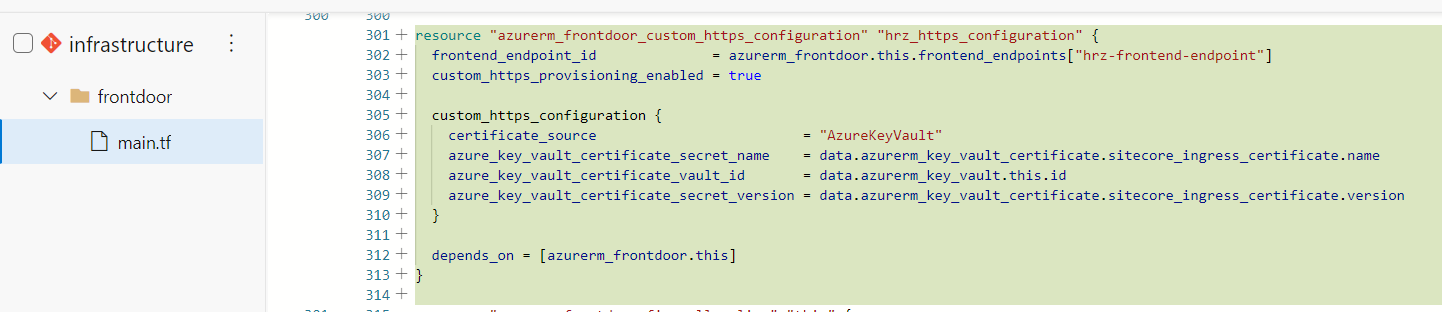
9. Define the `“azurerm_frontdoor_custom_https_configuration”` resource:
```csharp
resource "azurerm_frontdoor_custom_https_configuration" "hrz_https_configuration" {
frontend_endpoint_id = azurerm_frontdoor.this.frontend_endpoints["hrz-frontend-endpoint"]
custom_https_provisioning_enabled = true
custom_https_configuration {
certificate_source = "AzureKeyVault"
azure_key_vault_certificate_secret_name = data.azurerm_key_vault_certificate.sitecore_ingress_certificate.name
azure_key_vault_certificate_vault_id = data.azurerm_key_vault.this.id
azure_key_vault_certificate_secret_version = data.azurerm_key_vault_certificate.sitecore_ingress_certificate.version
}
depends_on = [azurerm_frontdoor.this]
}
```
10. Apply the changes to the environment with a pull request to the infrastructure repository.
The expected result:
11. Run the [FrontDoor pipeline](https://doc.sitecore.com/xp/en/developers/101/managed-cloud/the-managed-cloud-standard-pipelines.html "The Managed Cloud Standard pipelines") to apply the changes and wait until the pipeline is executed successfully.
Prepare the Docker files
To prepare the Sitecore platform images to work with the Horizon service:
- Install the Horizon integration asset image on top of Sitecore content management (CM) and MSSQL-INIT images.
Refer to the [Kubernetes deployment guide for Sitecore Horizon](https://dev.sitecore.net/Downloads/Sitecore_Horizon.aspx) for instructions on how to build corresponding custom images.
Push the images to the Azure Container Registry (ACR)
To push the images to the ACR:
- In PowerShell, [execute the docker push command](https://docs.docker.com/engine/reference/commandline/push/). You must push all images to the pre-provisioned ACR: `{infrastructure_id}acr`
Download the Horizon Container Deployment package
A prerequisite for adding the Horizon module is the Horizon Container Deployment package.
To download the package:
1. On [dev.sitecore.net](https://dev.sitecore.net/Downloads/Sitecore_Horizon.aspx), navigate to the page for the specific Sitecore version that you use and in the **Download options** section, go to **Container Deployment Package**.
2. Download the `SitecoreHorizonContainerDeployment` zip package and unarchive it to a local folder.
Copy the base Horizon Kubernetes configuration files
To copy the Horizon configuration files:
1. Navigate locally to the Application repository folder and create a folder with the following path:
```text
roles\sitecore-{topology}\bases\components\horizon
```
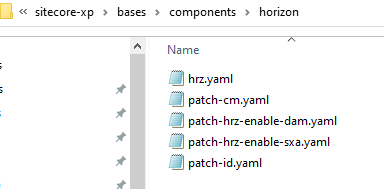
2. Copy the following Horizon base configuration files from the SitecoreHorizonContainerDeployment package into the folder that you created earlier:
- `k8s\ltsc2019\horizon\hrz.yaml`
- `* k8s\ltsc2019\horizon\ patch-hrz-enable-dam.yaml`
- `* k8s\ltsc2019\horizon\ patch-hrz-enable-sxa.yaml`
- `overrides\{topology}\patch-cm.yaml`
- `overrides\{topology}\patch-id.yaml`
> [!note]
> The files marked with \* are optional. They are required if you want integration with SXA and/or Dam. For more details about the SXA/Dam integration refer to the [Horizon deployment guide.](https://dev.sitecore.net/Downloads/Sitecore_Horizon.aspx)
3. In the folder created in step 1, create the `kustomization.yaml` file with the following content:
```
apiVersion: kustomize.config.k8s.io/v1alpha1
kind: Component
resources:
- hrz.yaml
patchesStrategicMerge:
- patch-id.yaml
- patch-cm.yaml
# Uncomment following line to enable DAM integration in the Horizon
#- patch-hrz-enable-dam.yaml
# Uncomment following line to enable SXA integration in the Horizon
#- patch-hrz-enable-sxa.yaml
```
Define Horizon configuration overlays
To integrate the Horizon module configuration with the Managed Cloud Containers environment, you must define an overlay layer on top of the Horizon base configuration. This abstraction makes it easier to replace the Horizon base configuration in Horizon module upgrades in future releases.
To define the overlays:
1. Create the `roles\sitecore-{topology}\overlays\components\horizon\cm.yaml` file with the following content:
```
---
apiVersion: apps/v1
kind: Deployment
metadata:
name: cm
spec:
progressDeadlineSeconds: 3600
template:
spec:
containers:
- name: sitecore-xp1-cm
image: "{{ docker_images.sitecore.cm }}"
env:
- name: SITECORE_HOSTNAME_HRZ
valueFrom:
secretKeyRef:
key: hrz
name: sitecore-hostname
- name: Sitecore_Horizon_ClientHost
value: "https://$(SITECORE_HOSTNAME_HRZ)"
```
2. Create the `roles\sitecore-{topology}\overlays\components\horizon\id.yaml` file with the following content:
```
---
apiVersion: apps/v1
kind: Deployment
metadata:
name: id
spec:
progressDeadlineSeconds: 3600
template:
spec:
containers:
- name: sitecore-xp1-id
image: "{{ docker_images.sitecore.id }}"
env:
- name: SITECORE_HOSTNAME_CM
valueFrom:
secretKeyRef:
key: cm
name: sitecore-hostname
- name: SITECORE_HOSTNAME_ID
valueFrom:
secretKeyRef:
key: id
name: sitecore-hostname
- name: SITECORE_HOSTNAME_HRZ
valueFrom:
secretKeyRef:
key: hrz
name: sitecore-hostname
- name: Sitecore_Sitecore__IdentityServer__AccountOptions__PasswordRecoveryUrl
value: "https://$(SITECORE_HOSTNAME_CM)/sitecore/login?rc=1"
- name: Sitecore_Sitecore__IdentityServer__Clients__DefaultClient__AllowedCorsOrigins__AllowedCorsOriginsGroup1
value: "https://$(SITECORE_HOSTNAME_CM)"
- name: Sitecore_Sitecore__IdentityServer__PublicOrigin
value: "https://$(SITECORE_HOSTNAME_ID)"
- name: SITECORE_ENVIRONMENT_TYPE
value: "{{ sitecore_environment_type }}"
- name: Sitecore_Sitecore__IdentityServer__Clients__DefaultClient__AllowedCorsOrigins__AllowedCorsOriginsGroup2
value: "https://$(SITECORE_HOSTNAME_HRZ)"
```
3. Create the `roles\sitecore-{topology}\overlays\components\horizon\hrz.yaml` file with the following content:
```
---
apiVersion: apps/v1
kind: Deployment
metadata:
name: hrz
spec:
progressDeadlineSeconds: 3600
template:
spec:
containers:
- name: sitecore-horizon
image: "{{ docker_images.sitecore.hrz }}"
env:
- name: SITECORE_HOSTNAME_HRZ
valueFrom:
secretKeyRef:
key: hrz
name: sitecore-hostname
- name: SITECORE_HOSTNAME_CM
valueFrom:
secretKeyRef:
key: cm
name: sitecore-hostname
- name: SITECORE_HOSTNAME_ID
valueFrom:
secretKeyRef:
key: id
name: sitecore-hostname
- name: Sitecore_Sitecore__Authentication__OpenIdConnectOptions__CallbackAuthority
value: "https://$(SITECORE_HOSTNAME_HRZ)"
- name: Sitecore_SitecorePlatform__ContentManagementInternalUrl
value: http://cm.{{ solution_id }}.svc.cluster.local
- name: Sitecore_SitecorePlatform__ContentManagementUrl
value: "https://$(SITECORE_HOSTNAME_CM)"
- name: Sitecore_Sitecore__Authentication__OpenIdConnectOptions__Authority
value: "https://$(SITECORE_HOSTNAME_ID)"
- name: Sitecore_Sitecore__Authentication__BearerAuthenticationOptions__Authority
value: "https://$(SITECORE_HOSTNAME_ID)"
```
4. Create the `roles\sitecore-{topology}\overlays\components\horizon\kustomization.yaml` file with the following content:
```
---
apiVersion: kustomize.config.k8s.io/v1beta1
kind: Kustomization
resources:
- sitecore-roles.yaml
patchesStrategicMerge:
- cm.yaml
- id.yaml
- hrz.yaml
```
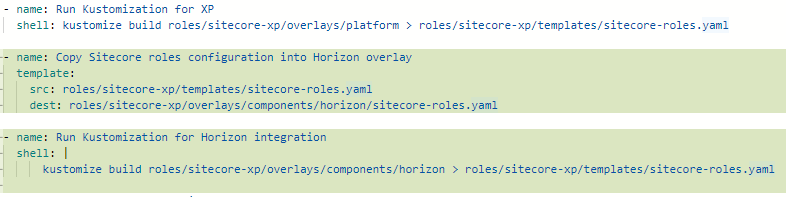
5. To execute the overlays, navigate to `roles\sitecore-{topology}\tasks\main.yaml` and add the following:
```
- name: Copy Sitecore roles configuration into Horizon overlay
template:
src: roles/sitecore-xp/templates/sitecore-roles.yaml
dest: roles/sitecore-xp/overlays/components/horizon/sitecore-roles.yaml
- name: Run Kustomization for Horizon integration
shell: |
kustomize build roles/sitecore-xp/overlays/components/horizon > roles/sitecore-xp/templates/sitecore-roles.yaml
```
The expected result:
> [!note]
> This code example is for XP topology. For XM, replace `‘sitecore-xp’` with `‘sitecore-xm’`.
Change the image in the Application repository
Now you can add the Horizon-specific image and two new properties to the Application repository.
To change the images in the Application repository:
- In the Application repository, navigate to `config/docker-images` and edit the `docker-images.json` file as follows:
- Replace the `cm` image with `cm-hrz`, that you created earlier.
- Add the `mssql_init_hrz` property, that you created earlier.
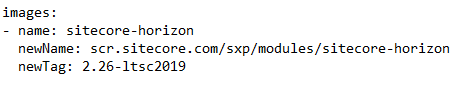
- Add the `hrz` property, and point it to the Horizon service public image that corresponds to your Sitecore version. You can find this value from Horizon artifacts downloaded earlier.
Navigate to `k8s\ltsc2019\horizon\kustomization.yaml` to find the actual image name and tag. For example:
Run the mssql_init_hrz container
To run the mssql-init-horizon container:
1. Navigate to `roles\sitecore-{topology}\templates\` and add the `mssql-init-horizon` job file under the name: `mssql-init-horizon.yaml` with the following content:
```
apiVersion: batch/v1
kind: Job
metadata:
name: horizon-mssql-init
spec:
template:
spec:
nodeSelector:
kubernetes.io/os: windows
imagePullSecrets:
- name: sitecore-docker-registry
containers:
- name: mssql-init-horizon
image: "{{ docker_images.sitecore.mssql_init_hrz }}"
env:
- name: sitecore_admin_password
valueFrom:
secretKeyRef:
name: sitecore-admin
key: sitecore-adminpassword.txt
- name: SQL_ADMIN_PASSWORD
valueFrom:
secretKeyRef:
name: sitecore-database
key: sitecore-databasepassword.txt
- name: SQL_ADMIN_LOGIN
valueFrom:
secretKeyRef:
name: sitecore-database
key: sitecore-databaseusername.txt
- name: SQL_SERVER
valueFrom:
secretKeyRef:
name: sitecore-database
key: sitecore-databaseservername.txt
- name: SQL_ELASTIC_POOL_NAME
valueFrom:
secretKeyRef:
name: sitecore-database
key: sitecore-database-elastic-pool-name.txt
- name: DATABASES_TO_DEPLOY
value: hrz
restartPolicy: Never
backoffLimit: 5
```
2. To add the Ansible tasks to execute the `mssql-init-horizon` job, navigate to `roles\sitecore-{topology}\tasks\init.yaml` and add the following script at the end of the file:
```
- name: Execute horizon mssql-init jobs
k8s:
apply: true
namespace: "{{ solution_id }}"
state: present
definition: "{{ lookup('template', 'mssql-init-horizon.yaml') }}"
- name: 'Wait - Horizon Mssql-init job'
k8s_info:
kind: Job
name: horizon-mssql-init
namespace: "{{ solution_id }}"
register: horizon_mssql_init_result
until: (horizon_mssql_init_result.resources[0].status.conditions[0].type | default('')) == 'Complete'
retries: 60
delay: 60
- name: Get all Horizon Mssql completed pods
k8s_info:
kind: Pod
namespace: "{{ solution_id }}"
label_selectors:
- job-name = horizon-mssql-init
no_log: true
register: horizon_mssql_pod_list
- name: Remove Horizon Mssql job's pods
k8s:
kind: Pod
name: "{{ item.metadata.name }}"
namespace: "{{ solution_id }}"
state: absent
no_log: true
with_items: "{{ horizon_mssql_pod_list.resources }}"
```
Configure Ingress
Next you must define and apply the Ingress configuration and define the secrets.
To configure Ingress:
1. In the Application repository, navigate to the `roles\sitecore-{topology}\templates\` folder and create the `ingress-hrz.yaml` file with the following content:
```
---
kind: Service
apiVersion: v1
metadata:
name: hrz-external
spec:
type: ExternalName
externalName: hrz.{{ solution_id }}.svc.cluster.local
ports:
- port: 80
---
apiVersion: extensions/v1beta1
kind: Ingress
metadata:
name: sitecore-hrz-ingress
annotations:
kubernetes.io/ingress.class: "nginx"
nginx.ingress.kubernetes.io/force-ssl-redirect: "false"
nginx.ingress.kubernetes.io/rewrite-target: /
nginx.ingress.kubernetes.io/proxy-buffering: "on"
nginx.ingress.kubernetes.io/proxy-buffers-number: "4"
nginx.ingress.kubernetes.io/proxy-buffer-size: "256k"
spec:
rules:
- host: "hrz.sitecore"
http:
paths:
- path: /
backend:
serviceName: hrz-external
servicePort: 80
```
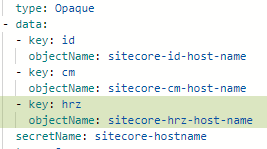
2. To define secrets, navigate to `roles\sitecore-{topology}\templates\secrets.yaml` and define the `sitecore-hrz-host-name` secret with `sitecore-secret-provider`.
3. Extend the `sitecore-hostname` secret:
```
- key: hrz
objectName: sitecore-hrz-host-name
```
The expected result
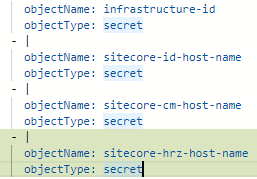
4. Add `sitecore-hrz-host-name` as a `secret-provider` parameter:
```
- |
objectName: sitecore-hrz-host-name
objectType: secret
```
The expected result:
5. Add the new task to `roles\sitecore-{topology}\tasks\main.yaml`:
```
- name: Install external horizon ingress service
k8s:
apply: true
namespace: "nginx"
state: present
definition: "{{ lookup('template', 'ingress-hrz.yaml') }}"
validate:
fail_on_error: yes
```
Enable the Horizon component
To enable the Horizon component:
- In the Application repository, navigate to the `roles\sitecore-{topology}\overlays\platform\kustomization.yaml` file and enable Horizon with the `components` element, pointing to the Horizon module configuration scripts folder.
```
components:
- ../../bases/components/horizon
```
Apply the changes
Now that you have made all the required changes for the Horizon module to be added, you must apply the changes.
To apply the changes:
1. Apply the application changes to the environment with a pull request to the application repository.
2. Follow Kubernetes deployment guide from [Horizon documentation](https://dev.sitecore.net/Downloads/Sitecore_Horizon.aspx) to configure the SolrCloud search indexes after deployment.