---
title: "AuthenticationTokenProvider class"
slug: "authenticationtokenprovider-class"
abstract: "Overview of the AuthenticationTokenProvider class used to support authentication and tokens in Commerce Connect APIs."
---
# AuthenticationTokenProvider class
To support authentication by using tokens in all of the Commerce Connect APIs, we have introduced an `AuthenticationTokenProvider` class. It consists of an interface defined in the `Sitecore.Commerce.Config` file and a default implementation that always returns `NULL`, meaning no token is provided.
The `Sitecore.Commerce.config` file defines the following authentication provider and `AuthenticationToken` entity configuration:
```xml
```
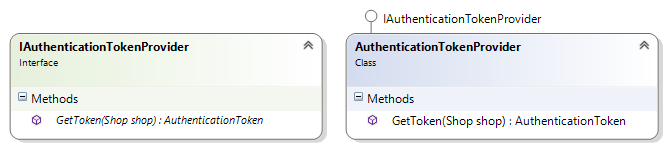
| Name | Description |
| --- | --- |
| **GetToken** | Must return the token if one is required. |
The introduction of the provider centralizes the logic of providing the Token. The `ServiceProviderRequest`base class that is used in all service methods as an input parameter has been extended with an `AuthenticationToken` property. The property can be set explicitly on every call made through Commerce Connect. If the property is not set, the `AuthenticationTokenProvider` class is instantiated and called, and the return value is assigned to the property.
The `AuthenticationToken` is defined as a class that can be customized for extensibility purposes.
The following is an example of how to explicitly pass the authentication token into a service call:
```
var request = new GetCustomerRequest(customerId);
var token = this.EntityFactory.Create("AuthenticationToken");
token.Token = "mytoken";
request.AuthenticationToken = token;
var result = this.CustomerServiceProvider.GetCustomer(request);
```