Examples of identity rules using unique identifiers
This topic includes examples of identity rules and IDENTITY events that use unique identifiers to perform identity resolution.
The examples in this topic are relevant to both the Sitecore CDP 2.0 data model and the 2.1 data model. If you are unsure of the data model your organization uses, ask your Sitecore representative.
You can verify a tenant's identity rules in system settings.
Organizations can use the identifiers array of JSON objects to identify guests in Sitecore CDP. An identifier is a unique string used to identify the guest, such as a unique ID from a Customer Relationship Management (CRM) system or loyalty program. Identifiers are not created by Sitecore CDP, they are created by your organization and sent to Sitecore CDP.
We recommend that you familiarize yourself with identity resolution before you review the examples.
Single identity rule
Your organization can configure a single identity rule that uses a unique identifier to identify a guest as a customer.
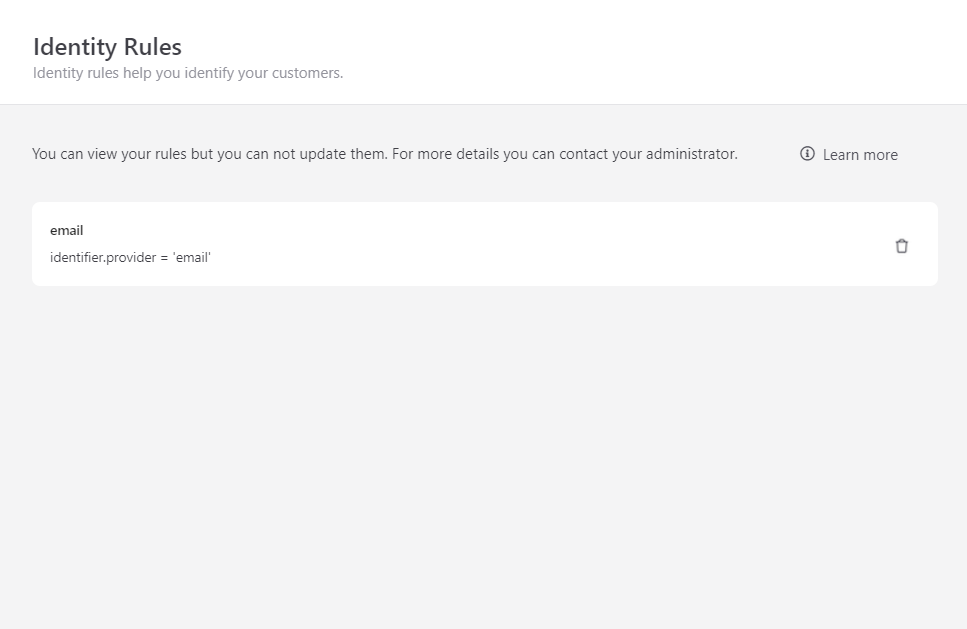
For example, your organization can use one identity rule, email address.
The identity rule for this configuration looks similar to the following image:
Using this same example, your organization can send an IDENTITY event that contains the id attribute with an email address as the string value.
If the string value for the id attribute is the same as an existing guest profile, Sitecore CDP migrates the guest's browsing data to the guest's existing guest profile, while retiring the other guest profile.
If the string value for the id attribute is not the same as an existing guest profile, Sitecore CDP creates a new guest profile with visitor as the guest type.
The following IDENTITY event meets the required identity rule because the identifiers array of JSON objects contains a value for the "id" attribute.
When Sitecore CDP receives the IDENTITY event, it evaluates the identity rule as follows:
-
Sitecore CDP locates the
identifiersarray of JSON objects and evaluates the value of theidattribute,"[email protected]". It searches the platform to find a guest profile with an identical string value of"[email protected]"for theidattribute. If it finds the identical string value in theidentifiersarray of JSON objects, it migrates the guest data including current session data to the guest profile with the customer guest type. Sitecore CDP adds theidentifiersobject to the guest profile, to use for identity resolution in the future. It retires the guest profile with the visitor guest type.You can use debug mode to view the guest profile in JSON format.
The following image displays a guest profile with the populated
identifiersobject: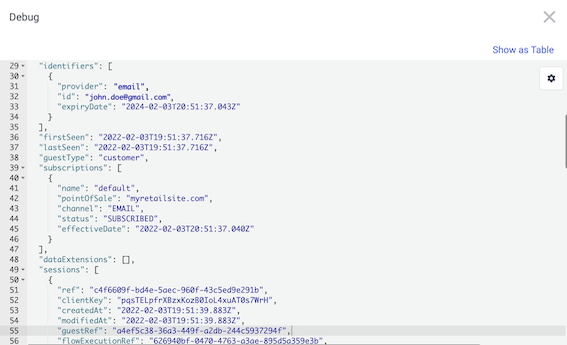
-
If Sitecore CDP does not find a guest with an identical string value,
"[email protected]", for theidattribute, it creates a guest profile with a visitor guest type.If a string value for the
idattribute is not provided for theSITECORE_IDattribute, Sitecore CDP creates a new guest profile with the visitor guest type.
Multiple identity rules
Your organization can configure multiple identity rules to use a unique identifier to identify a guest as a customer.
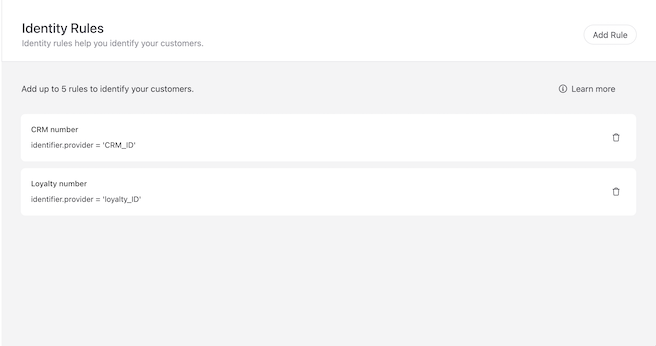
For example, your organization can use two identity rules: CRM_ID and loyalty_ID. You can configure Sitecore CDP to evaluate the identity rules using the equivalent of an OR operator, so that either identity rule can be used to identify a guest.
The identity rules for this configuration look similar to the following image:
Using this same example, your organization must send an IDENTITY event that contains a string value for the id attribute, for either the CRM_ID or loyalty_ID attributes, for Sitecore CDP to identify a guest. The following IDENTITY event meets the required identity rules because it contains at least one of the required id attributes:
When Sitecore CDP receives the IDENTITY event, it evaluates the identity rules in the order they are listed on the Identity Rules screen, as follows:
-
Sitecore CDP locates the
identifiersarray of JSON objects and evaluates theidattribute for the first identity rule, CRM number. It searches the platform to find a guest profile with an identical string value,"123456"for theidattribute. If it finds the identical string value in theidentifiersarray of JSON objects, it migrates the guest data including current session data to the guest profile with the customer guest type. It retires the guest profile with the visitor guest type. -
If Sitecore CDP does not find a guest with an identical string value for the
idattribute for the first identity rule, CRM number, it evaluates theidattribute for the next identity rule, Loyalty number. The following occurs:- If Sitecore CDP does not find a guest with an identical string value,
"xni8934y77", for theidattribute for the second identity rule, Loyalty number, it creates a guest profile with a visitor guest type. - If Sitecore CDP finds a guest with an identical string value,
"xni8934y77", for theidattribute for the second identity rule, Loyalty number, it migrates the guest data including current session data to the existing guest profile with the customer guest type. It retires the guest profile with the visitor guest type.
Sitecore CDP adds the
identifiersobject to the guest profile, to use for identity resolution in the future. You can use debug mode to view the guest profile in JSON format.The following image displays a guest profile with the populated
identifiersobject: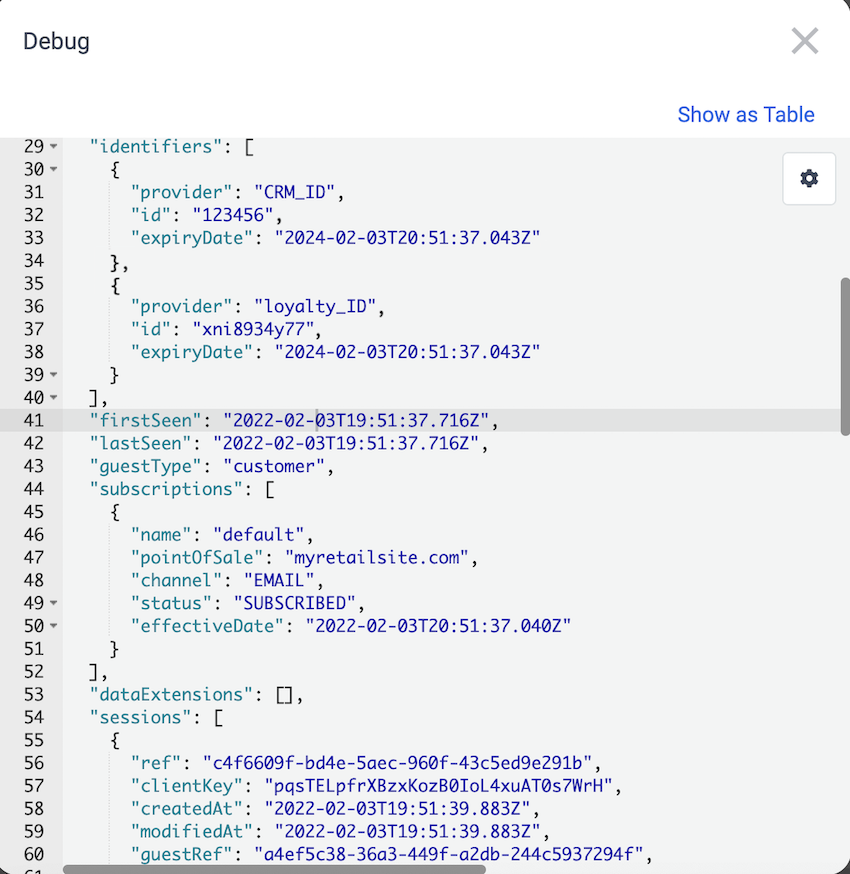
If a string value for the
idattribute is not provided for either theCRM_IDattribute orloyalty_IDattribute, Sitecore CDP creates a new guest profile with the visitor guest type. - If Sitecore CDP does not find a guest with an identical string value,