Import taxonomies
To configure Content Hub, you must either be a superuser or have the necessary permissions granted to you through user group policies.
You can use taxonomies to classify subsets of metadata. Taxonomies can contain multiple hierarchical values and control security. You can import hierarchical levels of a taxonomy using the Excel import feature.
- Ensure you have either a blank page or an existing page suitable for exporting data. This page must include a Creation component.
This walkthrough describes how to:
Create an empty taxonomy
To create an empty taxonomy:
- On the menu bar, click Manage .
- On the Manage page, click Taxonomy.
- On the Taxonomy page, click New taxonomy.
- In the New taxonomy dialog, fill in the Name and Label fields.
- Click Create.
Configure the Creation component
To configure the Creation component:
- On the component’s details page, turn on the Import Excel switch.
- In the right-hand pane, turn on the Enable migration mode switch.
- Click Save and close.
Import taxonomies
The imported Excel file can have any generic name (such as Entities), and must contain a worksheet with the same name as the taxonomy you wish to import, containing at least the following columns:
- Identifier - an identifier for the new taxonomy level using dot notation. For example, if the name of the new level is Province and the name of the taxonomy is BasicTaxonomy, the identifier is BasicTaxonomy.Province.
- TaxonomyName - the name of the taxonomy level.
- TaxonomyLabel#en-US - optional display label of the taxonomy level. If there are other portal languages, you can import them in the same file.
You can import a taxonomy with multiple levels by adding a field called taxonomyNameToSelf in the definition. As an example, the flag BasicTaxonomyToSelf:Parent indicates a parent-child relationship between a new taxonomy named BasicTaxonomyToSelf, and a parent taxonomy named Parent. Here, the OneToMany cardinality indicates that one BasicTaxonomy entity can be linked to many BasicTaxonomy sub-entities.
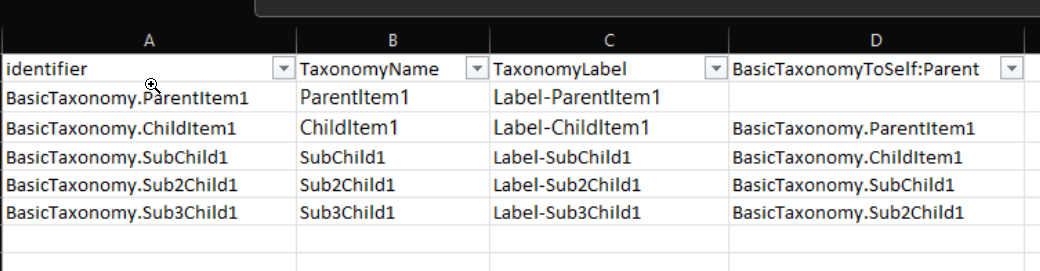
To import taxonomies:
- On the menu bar, click Manage .
- On the Manage page, click Pages.
- On the Pages page, select the page you created and click View page.
- On the new page, click Import Excel.
- In the import dialog, do one of the following:
- Drag and drop the files you want to upload.
- Browse to and open the files you want to upload.
- Click Upload
Column names can have up to 50 characters, and a single worksheet can have up to 50 definitions. The import ignores columns that do not match the corresponding definition. The language label used for each column is the Path value auto-generated from the Culture field. You can see this value when you click the desired language in Portal languages.
The order of the entities listed on the worksheet is important. To create the correct hierarchical relationships, entities at the first level must be listed first, followed by entities at each subsequent level. If you put a child entity at the first level of a taxonomy, it will appear at both parent and child levels. If this happens, do not delete it; instead, move it back to the correct level.
Move a child element
If you are not happy with the location of a child entity, you can move it.
To move a child element:
- Click Actions next to the entity.
- Select Move.
- Navigate to the required parent entity.
- Click Move to here.